

Short answer: Most law firm Google Ads budget is wasted on five things: broad match keywords with no negative list, sending every click to the home page, bidding on head terms instead of intent terms, ignoring the phone as a conversion, and optimising for cost per click rather than cost per signed case. Legal keywords are among the most expensive in Google Ads, so each of these mistakes costs more here than in any other industry.
Personal injury clicks routinely cost more than $100 and can exceed $200 in competitive metros. At those prices a mistake that would be a rounding error for a plumber costs a law firm thousands a month. This article covers the mistakes we see most often when firms hand us an existing account.
Mistake 1: Broad match with no negative keyword list
The most expensive mistake available. Broad match lets Google show your ad for anything it considers related, and “related” to a legal query is a very wide net.
A criminal defence firm bidding broadly on “criminal lawyer” will pay for people searching for criminal lawyer salaries, criminal law degrees, criminal lawyers on television, and free legal aid. None of them will ever retain you.
The fix: start with phrase and exact match. Then build a negative list before you spend anything, and keep adding to it weekly from the search terms report. A starting negative list for almost any firm:
free          salary        jobs          career        school
degree        course        how to become internship    template
pro bono      legal aid     public defender             volunteer
reddit        wikipedia     definition    meaning       movie
The search terms report is the single most valuable screen in the account and the one most firms have never opened. Read it every week for the first month.
Mistake 2: Sending every click to the home page
Someone searching “truck accident lawyer” clicks your ad and lands on a home page listing eight practice areas. They now have to find the one that applies to them, and a proportion of them simply leave — after you paid $90 for the click.
The fix: every ad group points at a page about that specific thing. Truck accident ads land on the truck accident page. This requires having those pages, which is the same structural argument as our guide to law firm practice area pages — and it is why paid and organic work should be planned together rather than by separate vendors.
Landing page relevance also feeds your Quality Score, which lowers what you pay per click. Doing this right makes the traffic both cheaper and better.
Mistake 3: Bidding on head terms instead of intent terms
“Personal injury lawyer” is the most expensive and least specific phrase you can buy. The people typing it include students, insurance adjusters, other lawyers, and people at the very beginning of thinking about it.
Longer queries cost less and convert better because they describe a situation rather than a category:
- “rear ended by company truck lawyer”
- “can i sue after signing insurance release”
- “lawyer for denied disability claim [city]”
- “emergency custody hearing attorney [county]”
Lower volume individually. Far less competition, and the searcher has a problem rather than a curiosity.
Mistake 4: Not tracking calls
Most law firm enquiries arrive by phone, and a large share of accounts we inherit are optimising exclusively on form fills. Google is then optimising toward the minority of your conversions, and you are judging campaigns on a fraction of their output.
The fix: call tracking with a dynamic number, call conversions configured with a sensible minimum duration — sixty seconds filters out wrong numbers — and, critically, the discipline to record which calls became signed matters. Without that last step you are still guessing.
Mistake 5: Optimising for cost per click, not cost per case
The metric that matters is what a signed matter costs you, and it is the one most firms cannot state. A campaign at $40 per click producing a case every twenty clicks beats a campaign at $12 per click producing one every two hundred.
Work the chain backwards: average fee, close rate from consultation, consultation rate from enquiry. That tells you what you can afford to pay per enquiry, and everything above it becomes a decision rather than an anxiety. The same arithmetic applies to organic spend — we work through it in how much law firm SEO costs per month.
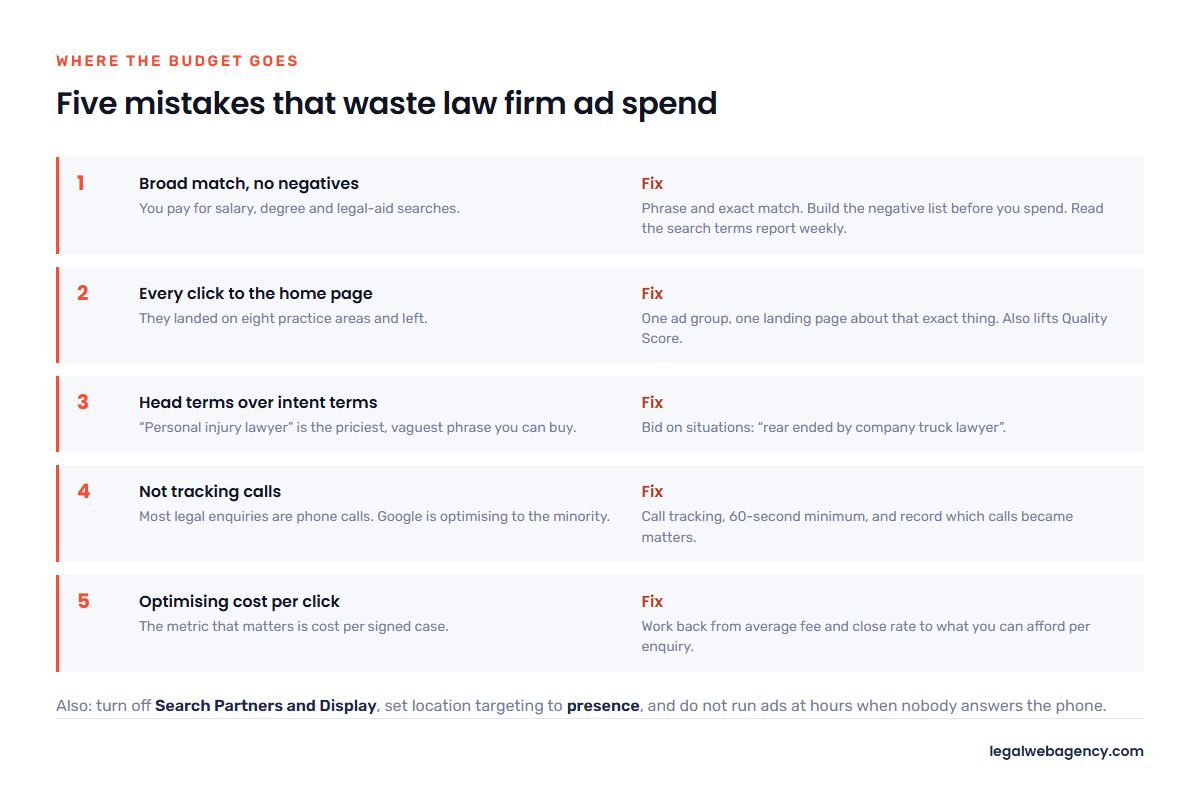
Five more that cost real money
- Leaving Search Partners and the Display Network on. Both are enabled by default on Search campaigns and both quietly consume budget at much lower intent. Turn them off until Search alone is working.
- Untargeted geography. Set radius targeting around the courthouses you actually practise near, and set location options to “presence” rather than “presence or interest” — otherwise you pay for people merely reading about your city.
- Running ads outside the hours you answer the phone. If nobody picks up at 8pm, either schedule ads to your staffed hours or get an answering service that can take an intake. Paying $90 for a click that reaches voicemail is the purest form of waste in the account.
- Ignoring Local Services Ads. For many practice areas LSAs sit above the traditional ads, are priced per lead rather than per click, and carry the Google Screened badge. They require licence and insurance verification, and for a lot of firms they are cheaper per case than Search.
- Letting the account run unattended. Legal auctions move. An account nobody has opened in three months is an account leaking money.
The compliance layer nobody mentions
Your state bar’s advertising rules apply to paid ads exactly as they apply to your website. Ad copy is a communication about your services.
- No implied guarantees. “We win” in a headline is a compliance problem even where the landing page is careful.
- Required disclaimers must be reachable — which in practice means the landing page carries them, because a headline cannot.
- Some states have specific rules on advertising specialisation or certification, so “specialist” and “expert” need checking before you use them in ad copy.
- Case results in ad extensions carry the same disclaimer obligations as on your site.
Full state-by-state detail is in attorney advertising rules by state. This article is marketing guidance, not legal or ethics advice.
A sane starting structure
- One campaign per practice area, so budget cannot leak between them.
- Tight ad groups — a handful of closely related phrase and exact match keywords each.
- A dedicated landing page per ad group.
- A negative keyword list applied at account level from day one.
- Call tracking live before the first click.
- Search only. No Display, no Search Partners.
- Location targeting set to presence, around where you actually practise.
- Ad scheduling matched to when someone answers.
Then leave it alone for two weeks, read the search terms report, and cut what is not working. Most accounts improve more from subtraction than from addition.
Frequently asked questions
How much should a law firm spend on Google Ads?
Enough to generate statistically meaningful data in your market, which usually means at least 30–50 clicks a month per practice area. In expensive niches that is a substantial number. If your budget cannot reach it, concentrate on one practice area rather than spreading thin.
Are Google Ads worth it for law firms?
They can be, where case values are high and you can answer the phone. They are immediate, which SEO is not. They also stop the moment you stop paying, which is why most firms should run both — ads for flow now, SEO to bring the long-run cost per case down.
Why are legal keywords so expensive?
Because a single case can be worth tens or hundreds of thousands, firms can rationally bid a great deal for one click. That is also why precision matters more here: you are paying premium prices for every unqualified visitor you fail to exclude.
Should I use Local Services Ads instead?
Try both. LSAs are priced per lead rather than per click, appear above traditional ads, and carry the Google Screened badge, which converts well. They require verification of licence and insurance, and availability varies by practice area and location.
Running ads and unsure where the budget is going? Give us read-only access and we will send you the wasted spend we find, whether or not you work with us.