

Short answer: Some do, most say they do, and the difference is whether SEO is a line item with named deliverables or a bullet point on a sales page. A designer who “includes SEO” usually means they installed Yoast. A designer who genuinely includes it will tell you, before you sign, which pages they are building, what the URL structure will be, who writes the content, and what happens to your rankings during migration.
Almost every attorney web designer lists SEO on their services page, because almost every firm asks about it. That makes the claim useless as a filter. This article covers what “included SEO” actually means at each price point, the questions that separate the two, and how to read a proposal.
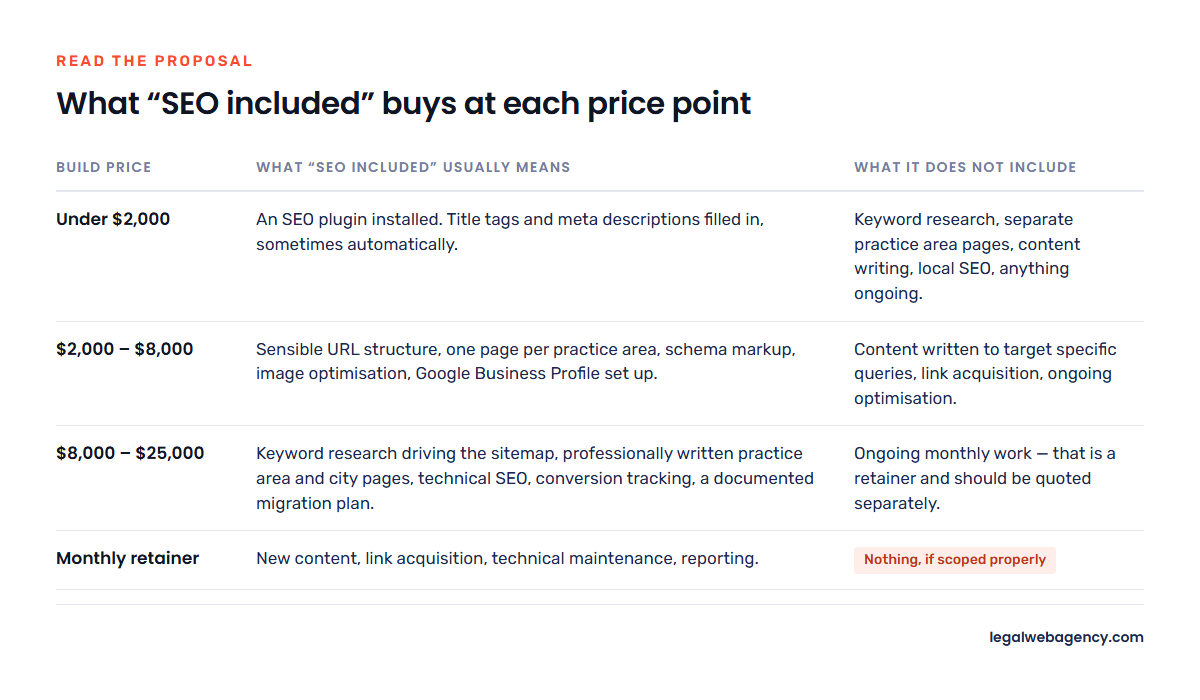
What “includes SEO” means at each price point
| Build price | What “SEO included” usually means | What it does not include |
|---|---|---|
| Under $2,000 | An SEO plugin installed. Title tags and meta descriptions filled in, sometimes automatically. | Keyword research, separate practice area pages, content writing, local SEO, any ongoing work. |
| $2,000–$8,000 | The above plus a sensible URL structure, one page per practice area, schema markup, image optimisation, and a Google Business Profile set up. | Content written to target specific queries, link acquisition, ongoing optimisation. |
| $8,000–$25,000 | Keyword research driving the sitemap, professionally written practice area and city pages, technical SEO, local SEO, conversion tracking, and a documented migration plan. | Ongoing monthly work — that is a retainer, and it should be quoted separately. |
| Monthly retainer | The ongoing part: new content, link acquisition, technical maintenance, reporting. | Nothing, if it is scoped properly. See what law firm SEO costs per month. |
The important distinction is between SEO-ready and SEO-performing. A build can leave you with a technically sound site that ranks for nothing, because ranking requires content and authority accumulated over months. A designer can honestly deliver the first. Only a retainer delivers the second.
Any designer implying that a build alone will get you ranking is either inexperienced or selling. Our breakdown of how long it takes to rank a law firm website covers the realistic curve.
The seven questions that separate them
Ask these before you sign. The answers are more informative than any portfolio.
1. “How many pages will the site have, and what determines that number?”
A designer doing real SEO answers with keyword research: one page per practice area you want cases in, plus location pages where you genuinely practise. A designer doing decoration answers with a package tier — “five pages” — which is a design constraint pretending to be a strategy.
2. “Will each practice area get its own page?”
If the answer is a single combined “Practice Areas” page, the site cannot rank for your services and no amount of later optimisation fixes it without a restructure. This is the highest-consequence structural question in the whole build — see law firm practice area pages.
3. “Who writes the content, and does an attorney review it?”
Content is where most of the SEO value and most of the cost sits. The three honest answers are “you do”, “we do and you approve”, or “we do a first draft from an interview with you”. Any of those is fine. What is not fine is silence, or generated content nobody reviews — which on a legal site is both an SEO problem and a professional responsibility problem.
4. “What happens to my rankings during migration?”
The single most revealing question if you have an existing site with traffic. The right answer involves a URL map, 301 redirects for every changed URL, a pre-launch crawl and a post-launch Search Console check. The wrong answer is “it should be fine”. Firms lose years of accumulated visibility in a single bad launch — our redesign guide covers how.
5. “Show me a law firm site you built, and its traffic twelve months later.”
Screenshots prove design. Numbers prove outcome. Very few designers can produce the second, and the ones who can are a different category of vendor. Accept anonymised data if client confidentiality is genuinely the issue — but “we don’t share that” with no alternative usually means it does not exist.
6. “Do I own the site, the content, the domain and the analytics accounts?”
The only acceptable answer is yes to all four, in your firm’s name, from day one. Designers who own your domain or build on a proprietary platform you cannot export have made leaving them expensive by design.
7. “Do you understand my state’s attorney advertising rules?”
A blank look here disqualifies a firm claiming to be a legal specialist. They should know that New York wants “Attorney Advertising” on the home page, that results and testimonials carry disclaimer obligations, and that award badges need accompanying language in New Jersey. Full detail in attorney advertising rules by state.
How to read the proposal
Three signals in the document itself:
- Is SEO a priced line item or a bullet point? If it appears only in a feature list with no hours or deliverables attached, it is marketing rather than scope.
- Are deliverables countable? “SEO optimisation” is not a deliverable. “Keyword research for six practice areas, 8 pages written to 1,200+ words, schema markup, GBP setup, redirect map” is.
- Is the ongoing work quoted separately? It should be. A build price that silently includes “three months of SEO” is usually a build price with three months of nothing attached.
If you are comparing several vendors, put all of this in a written brief so the proposals come back comparable — our law firm website RFP guide includes a template you can copy.
The three vendor types
- Designers. Good at design, honest ones say SEO is not their discipline. Fine if you have someone else doing SEO. Cheapest.
- Legal marketing agencies. Build and rank, understand bar compliance, price accordingly. Best fit for most firms who want one accountable vendor.
- Template resellers. Same site with your logo, sold at volume, “SEO included” meaning a plugin. Cheap and occasionally adequate for a solo who needs a presence rather than a pipeline.
None of these is wrong. The failure is buying the third while expecting the second. More on evaluating vendors in how to choose a web designer for your law firm.
Frequently asked questions
Do attorney website designers include SEO?
Most claim to. What is genuinely included varies from an installed plugin at the low end to keyword-driven site architecture and professionally written content at the high end. Ask for the deliverables in writing rather than relying on the claim.
Should I hire one company for design and SEO, or two?
One, if they can genuinely do both — site structure and content are shared between the two disciplines, and splitting them creates arguments about whose fault the rankings are. Two is fine if the designer is honest that SEO is not their strength.
Will a new website automatically rank better?
No. A new site can rank worse if URLs change without redirects. Better rankings come from structure plus content plus authority over months. A good build removes the obstacles; it does not by itself produce the result.
How much should I pay for a law firm website with SEO included?
Meaningful SEO work as part of a build generally starts around $5,000 and rises with the number of pages. Our full ranges, including our own, are on the pricing page.
Comparing proposals and unsure whether the SEO in them is real? Send them over. We will tell you which deliverables are substantive and which are filler — including on ours.