

Short answer: A law firm website RFP is a written brief that tells agencies what you need, what you already have, what you will spend, and how you will decide — so that the proposals you get back are actually comparable. A good one runs three to six pages, states a budget range, and asks every agency the same questions. It usually saves a firm more money in avoided rework than the whole procurement process costs.
Most law firms skip the RFP. They email three agencies, get back three documents structured completely differently, discover that one includes content and one does not and one is silent on hosting, and pick on price — which by then is not comparing the same thing.
An RFP fixes that in an afternoon of work. Below is what to put in one, the questions that separate a real agency from a good salesperson, and a complete template you can copy.
When an RFP is worth writing — and when it is not
Write one if: the project is over roughly $10,000; more than one person at the firm has to agree; you are migrating an existing site with real traffic; or you have been burned before and want commitments in writing.
Skip it if: you are a solo with a $2,000 budget and a five-page site. A formal RFP for a small build costs both sides more than it saves, and the good agencies will decline to respond. A one-page brief and two conversations is the right process at that size.
What goes in a law firm website RFP
1. Who you are
Firm size, practice areas in order of commercial priority, the markets and states you serve, and who your typical client is. Agencies price differently for a personal injury firm in Los Angeles than for an estate planning practice in Vermont, and they should.
2. What you have now
Current URL, platform, host, roughly how many pages, monthly traffic, and where enquiries currently come from. Say plainly what is wrong with it — “it looks dated” and “it does not generate calls” are different problems with different solutions.
3. What you want the new site to do
Business outcomes, not features. “Increase consultation requests from organic search by 50% within twelve months” is a brief. “Modern, professional design” is a preference. Agencies who can only respond to the second kind will produce something pretty that does not change your caseload.
4. Scope
Be explicit, page type by page type: home, about, attorney bios (how many), practice areas (how many), location pages (how many), blog, contact, results, plus any privacy policy and disclaimer pages. Then say who writes the words. Content is the single most common scope dispute in web projects and the single easiest one to prevent.
5. Technical and compliance requirements
Platform preference, integrations (practice management system, live chat, call tracking, e-signature, payment), accessibility standard, and — specific to your industry — your state bar advertising requirements. If you practise in New York, the site needs “Attorney Advertising” on the home page. If you practise in New Jersey, award badges need specific accompanying language. Put those in the RFP so the agency prices for them rather than discovering them at launch.
6. Budget range
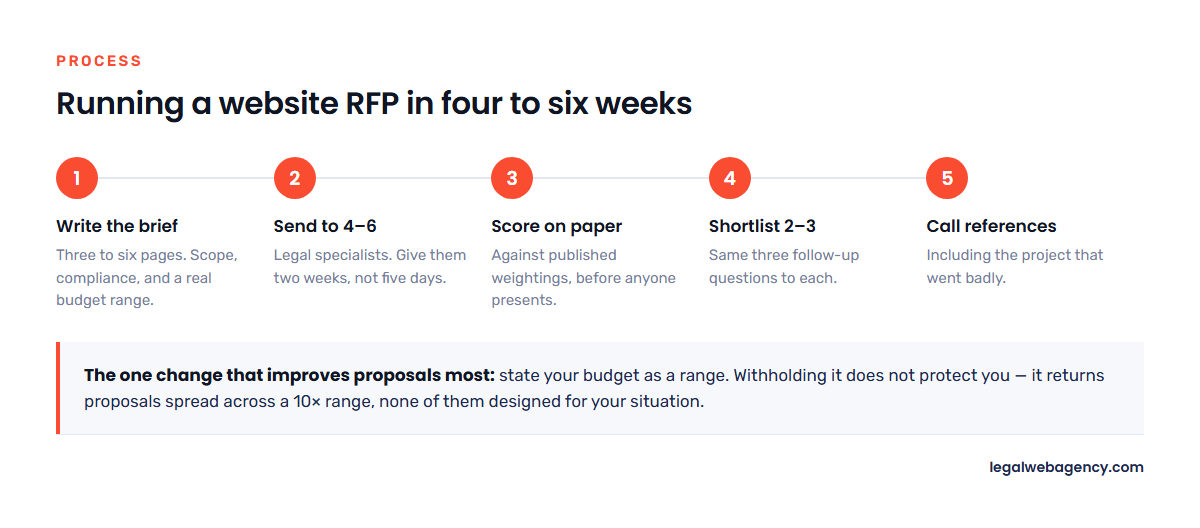
State it. Firms withhold the budget believing it protects them from being quoted up to it. What actually happens is that you receive proposals spread across a 10x range, none of which are designed for your situation, and you waste three weeks. Give a range — “$15,000–$25,000 for the build, plus up to $2,000 per month ongoing” — and let agencies show you what they would do inside it.
7. Timeline and decision process
RFP issue date, question deadline, submission deadline, shortlist date, decision date, target launch. Name the decision-maker. Agencies price risk into projects where they cannot tell who is signing.
8. Evaluation criteria, weighted
Publish how you will score. Something like: legal industry experience 25%, demonstrated results 25%, proposed approach 20%, price 20%, cultural fit 10%. This forces you to decide what you value before you are dazzled by a slide deck, and it dramatically improves the quality of what you receive.
The questions that separate agencies
Put these in the RFP verbatim. The answers are more revealing than any portfolio.
- Show us three law firm sites you built, with before-and-after traffic or enquiry data. Screenshots prove design. Numbers prove outcome. Very few agencies can produce the second.
- Who specifically will do the work, and who else are they working on that month? Pitch teams and delivery teams are frequently different people.
- Who writes the content, and does an attorney review it before publication?
- How do you handle state bar advertising compliance? A blank look here is disqualifying for a legal specialist.
- What happens to our rankings during migration? The right answer involves a URL map, 301 redirects, and a pre-launch crawl. The wrong answer is “it should be fine.”
- Who owns the domain, the site files, the content, and the analytics accounts after launch? The only acceptable answer is: the firm does, all four.
- What is included after launch, for how long, and what is billable?
- What does it cost to leave? Ask directly. Some agencies build on proprietary platforms you cannot take with you.
- Give us three law firm references we can call, including one project that went badly. The second half of that question is the useful half.
Our longer guide to choosing a web designer for your law firm goes through how to weigh the answers.
The law firm website RFP template
Copy this into a document, fill in the brackets, delete what does not apply, and send it. It is deliberately short — a 30-page RFP for a $20,000 website filters out the good agencies rather than the bad ones.
REQUEST FOR PROPOSAL — LAW FIRM WEBSITE
[Firm Name] | Issued [date]

1. ABOUT OUR FIRM
Firm name, size, year founded:
Practice areas, in order of commercial priority:
Offices and markets served:
States where our attorneys are licensed:
Our typical client:
What makes us different from the firm down the street:

2. CURRENT SITUATION
Current website URL:
Platform / CMS / host:
Approximate number of pages:
Monthly organic traffic (if known):
Current sources of new matters:
What is not working, in our own words:

3. OBJECTIVES
Primary business objective:
Secondary objectives:
How we will measure success at 6 and 12 months:

4. SCOPE OF WORK
Pages required:
  Home, About, Contact
  Attorney bios: [number]
  Practice area pages: [number]
  Location pages: [number and which cities]
  Blog / insights section: [yes/no]
  Case results: [yes/no]
  Required legal pages: privacy policy, disclaimer, accessibility statement
Content: [we will supply / agency to write / hybrid — specify per page type]
Photography and video: [we will supply / agency to arrange / stock]
Migration of existing blog content: [yes/no — approx. number of posts]

5. TECHNICAL REQUIREMENTS
Platform preference:
Must integrate with: [practice management system, live chat, call tracking,
  e-signature, payment processor, CRM]
Accessibility target: WCAG 2.1 AA
Performance target: Core Web Vitals passing on mobile
Hosting: [agency to provide / we will provide]
Ownership: firm to own domain, site files, content and all analytics accounts

6. COMPLIANCE REQUIREMENTS
Our governing state bar(s): [list]
Known requirements: [e.g. "Attorney Advertising" label on home page (NY);
  award methodology and Supreme Court disclaimer language (NJ);
  results and testimonial disclaimers]
The successful agency must confirm familiarity with these requirements.

7. BUDGET
Design and build: $[range]
Ongoing monthly (SEO / maintenance / content): $[range]
Please state clearly what is and is not included at the price quoted.

8. TIMELINE
RFP issued: [date]
Questions due: [date]
Proposals due: [date]
Shortlist notified: [date]
Presentations: [date]
Decision: [date]
Target launch: [date]

9. EVALUATION CRITERIA
Legal industry experience and portfolio      25%
Demonstrated results for comparable firms    25%
Proposed approach and understanding of brief 20%
Price and value                              20%
Team, communication and cultural fit         10%

10. WHAT TO INCLUDE IN YOUR PROPOSAL
  a. Your understanding of our objectives (1 page)
  b. Proposed approach and process
  c. Three relevant law firm examples with outcome data
  d. Named team and their roles
  e. Project plan and timeline
  f. Itemised pricing, including anything excluded
  g. Post-launch support terms and hourly rate for out-of-scope work
  h. Answers to the nine questions in Appendix A
  i. Three references, including one project that did not go to plan

11. SUBMISSION
Email to: [name, title, address]
Format: PDF, maximum [15] pages excluding appendices
Deadline: [date and time, with timezone]
Questions to: [address] by [date]. Answers will be shared with all respondents.

APPENDIX A — QUESTIONS ALL RESPONDENTS MUST ANSWER
[paste the nine questions above]
How to run the process once proposals arrive
- Score before you meet anyone. Use your published criteria, on paper, so a strong presentation cannot overwrite a weak proposal.
- Shortlist two or three. More than three presentations and every proposal blurs together.
- Ask each shortlisted agency the same three follow-ups. Comparability is the entire point of the exercise.
- Call the references, including the difficult one. Ask what happened when something went wrong and how it was handled.
- Have your own counsel read the contract. Check ownership of deliverables, payment schedule tied to milestones, what happens if the project stalls on your side, and the notice period on any ongoing retainer.
- Tell the unsuccessful agencies why. It costs you five minutes and it is how you keep good agencies willing to bid next time.
The three RFP mistakes that cost firms the most
- Hiding the budget. Covered above, and it is the most common. It does not get you a better price; it gets you incomparable proposals.
- Leaving content ownership vague. “Agency will assist with content” is not a scope. Specify who writes each page type, who reviews it, and how many revision rounds are included.
- Forgetting the migration plan. If you have an existing site with rankings, the redirect map is more commercially important than the design. Firms lose years of accumulated search visibility in a single bad launch — our law firm website redesign guide covers how to avoid it.
Frequently asked questions
How long should a law firm website RFP be?
Three to six pages plus appendices. Long enough to be specific about scope, budget and compliance; short enough that good agencies will actually respond.
How many agencies should I send it to?
Four to six. Fewer and you have no comparison; more and the evaluation becomes a job in itself. Prefer agencies with genuine legal experience — a generalist will spend your budget learning your compliance obligations.
Should I include the budget in the RFP?
Yes, as a range. It is the single change that most improves the quality of the proposals you receive.
How long does the whole process take?
Four to six weeks from issuing the RFP to signing, if you set the dates in advance and hold to them. Build in two weeks for agencies to respond properly — a five-day turnaround gets you recycled boilerplate.
What should a law firm website cost?
It varies enormously with scope. We publish real ranges, including our own, on our law firm website pricing page and in our breakdown of how much a law firm website costs.
Writing an RFP and want a sanity check on the scope before you send it? Send us the draft. We will tell you what agencies will find ambiguous — even if you are not planning to invite us.